
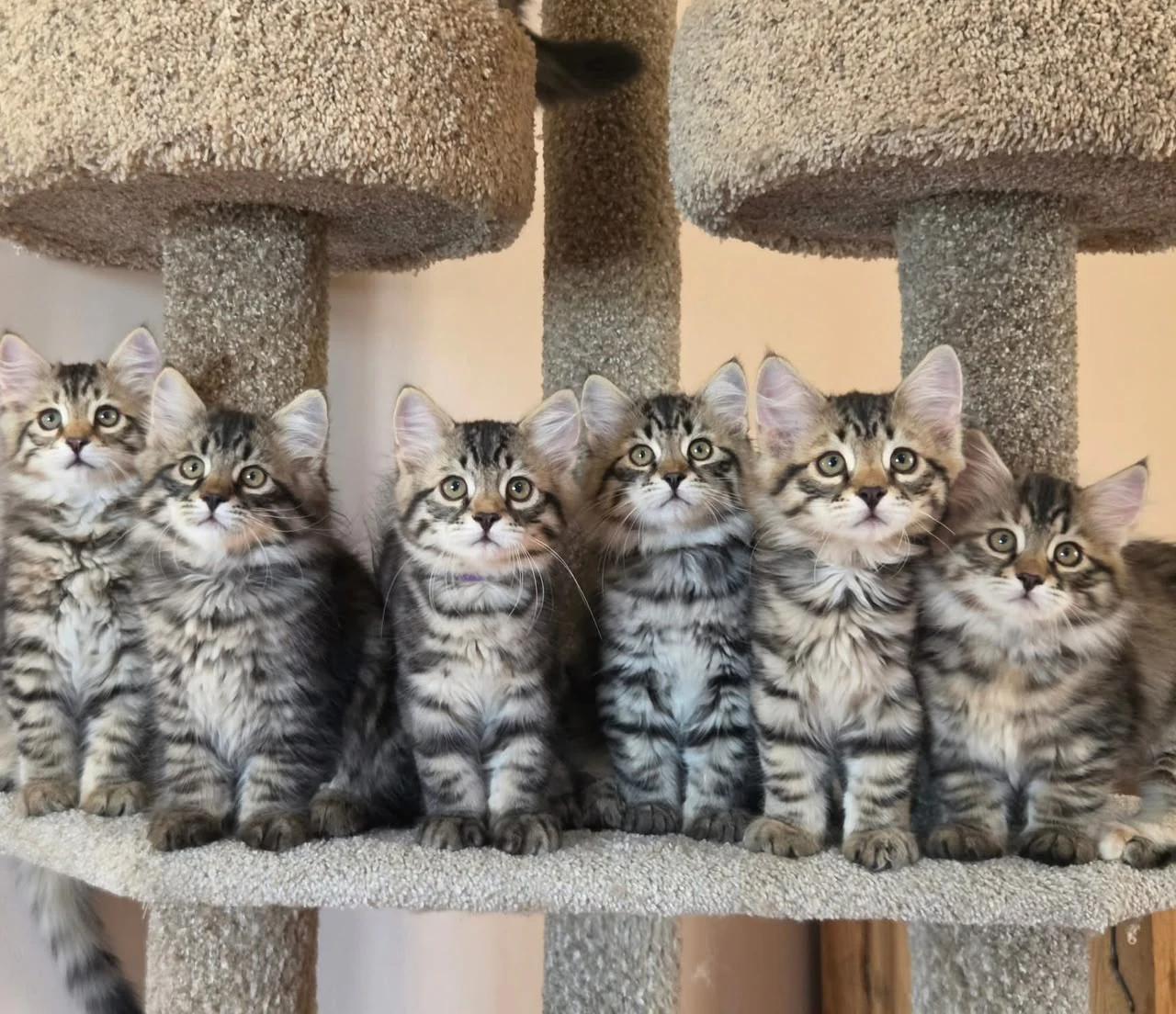
Brown Tabby
Warm brown backgrounds with darker markings create the woodland appearance often associated with Siberians.
History, Personality, Appearance & Care
Get to know this intelligent, affectionate forest cat and what sharing your home with one involves.
Meet Our Available KittensWith a luxurious triple coat, expressive eyes, and an impressive build, the Siberian is a captivating natural breed. Originating in Russia, these forest cats have become companions for families who appreciate their playful intelligence and striking appearance.
Whether you are comparing long-haired breeds or looking for Siberian kittens in Texas, this guide covers their history, characteristics, and everyday care.
The Siberian is a naturally developed, medium-to-large domestic cat breed originating from Russia. Known for its powerful physique, dense semi-long coat, and affectionate personality, it combines the strength of a forest cat with the warmth of a family companion.
Unlike breeds developed primarily for unusual physical features, the Siberian evolved through generations of adaptation to challenging conditions. Its musculature, substantial bone structure, and protective coat reflect its origins in Russia’s colder regions.
Despite their impressive size, Siberians are agile. They enjoy climbing, jumping, investigating their surroundings, and participating in family activities.
The Siberian’s story reaches back centuries. Historical references associated with the breed date to around the year 1000. These cats lived alongside farmers, merchants, and families, where their hunting abilities made them useful companions.
Their dense coats helped protect them in cold weather, while their intelligence and adaptability suited life around people. Siberians also appear in Russian folklore, with a reputation for cleverness and companionship.
The first breeding Siberians arrived in the United States in 1990. Recognition by major cat associations followed.
Today, Siberians are appreciated across the United States, including Texas, for their appearance and engaging personalities.
A Siberian has a powerful yet balanced body, rounded contours, a full coat, and an expressive face. Their overall appearance should suggest strength without losing that gentle expression.
Siberians have substantial musculature, strong legs, and broad, rounded paws. CFA describes mature males as commonly weighing 12–18 pounds and females 8–12 pounds. Individual cats may fall outside these ranges depending on genetics, development, and body condition.
Their hind legs are slightly longer than their front legs, contributing to their jumping ability. A healthy Siberian should feel solid and muscular rather than simply heavy.
The head is a broad, modified wedge with rounded contours and a full muzzle. Medium-sized ears often have generous furnishings. Expressive eyes may be green, gold, copper, or related shades; blue eyes occur with certain colors, including pointed coats. White cats and cats with white may also have blue or odd-colored eyes.
A thick, well-furnished tail completes the forest-cat appearance.
Siberians develop slowly. Some continue filling out in muscle, coat, and overall appearance for three to five years. A young Siberian can look quite different from a fully mature adult. Gradual development is part of the breed, although concerns about an individual kitten’s growth should be discussed with a veterinarian.
The dense, weather-resistant triple coat is one of the Siberian’s best-known features. Its layers vary in density and texture, giving the coat its characteristic fullness.
During colder months, the coat may become thicker, with a prominent neck ruff, full tail, and abundant fur around the hindquarters. It typically becomes lighter as the winter coat sheds.
For indoor Siberians in Texas, daylight, indoor conditions, and seasonal changes can all influence the coat.
Yes. Some shed noticeably during seasonal coat changes. Although their coats can be manageable for a long-haired breed, regular grooming helps remove loose hair and prevent tangles. Shedding and grooming needs vary between individual cats.
From richly marked tabbies to silvers and soft creams, Siberians have a wide variety of colors and patterns.
Warm brown backgrounds with darker markings create the woodland appearance often associated with Siberians.
A pale background or undercoat contrasts with darker tipping or tabby markings.
Warm golden tones range from soft honey shades to richer coloring.
In cat terminology, blue means a soft gray color. It can appear in solid, tabby, and other patterns.
Cream is soft and pale; red has warmer orange or reddish tones. Both have variations in pattern and intensity.
Siberians can be solid black or white, or have combinations with small or extensive white markings.
Colorpoint Siberians have darker coloring on the face, ears, legs, and tail, often with blue eyes. The name Neva Masquerade is commonly associated with pointed Siberians, though naming and classification vary between registries. CFA recognizes pointed colors within the Siberian breed.
Whatever the color, health, individual temperament, and suitability for your home matter more than appearance alone.
Siberians are often affectionate, intelligent, and playful. Many form close relationships with their people and like to be involved in everyday activities, following family members from room to room to see what is happening.
Many enjoy attention, gentle handling, interactive play, and resting near familiar people. Every cat has its own personality, shaped by genetics, early experiences, socialization, and the home environment.
Siberians can be lovely companions for families with respectful children. Supervise young children with kittens, teach gentle handling, and give the cat places to rest undisturbed.
Many Siberians can live successfully with cat-friendly dogs and other pets. Introductions should be gradual and supervised, giving each animal time and space to become comfortable.
Siberians often stay playful into adulthood. Stable climbing structures, interactive games, puzzle feeders, and safe toys offer ways to use their curiosity and athletic ability. Put wand toys and loose strings away when play is finished.
Siberians are sometimes described as a better choice for people with cat allergies. No cat breed, however, is guaranteed to be hypoallergenic.
Many cat allergies involve Fel d 1, a protein associated with cats’ saliva and skin secretions that spreads through grooming. Claims about lower allergen levels in Siberians do not tell you how you will react to a particular cat.
If allergies are a concern, speak with an appropriate medical professional before adopting. Individual reactions vary, and a brief visit cannot guarantee that symptoms will not develop later.
Read our Siberian Cats & Allergies Guide →Regular home grooming is the foundation of coat care. Some Siberians need more help than others, especially during seasonal shedding.
A few gentle grooming sessions each week can be a useful starting point, with adjustments for your cat’s coat. Check behind the ears, under the legs, around the hindquarters, and along the belly for tangles. Ask a groomer or veterinarian for help with mats rather than cutting them out yourself.
Short, gentle sessions during kittenhood help make handling familiar.
Provide sturdy scratching surfaces and make nail care, ear checks, and dental care part of your routine. Your veterinarian can show you suitable techniques and recommend an oral-health plan.
Frequent bathing is generally unnecessary unless the cat is significantly soiled or a veterinarian recommends it. Use cat-safe products and keep handling calm.
Explore our Kitten Care Guide →Siberians are a naturally developed breed, but they are not immune to inherited or acquired health conditions. TICA lists a typical lifespan of approximately 11–18 years or more. That range is a breed reference, not a promise about an individual cat.
HCM involves thickening of the heart muscle and can affect Siberians. Discuss cardiac screening and family history when choosing a breeder. Echocardiography—an ultrasound of the heart—is used to assess heart structure. A normal screening result does not guarantee that heart disease will never develop.
Like other cats, Siberians can experience dental disease, obesity, parasites, infections, and other illnesses. An individual preventive-care plan should cover:
Ask a breeder which tests have been performed, which records are available, and what the written agreement includes.
Read our Health & Guarantee Information →References: TICA breed profile and Cornell Feline Health Center: cardiomyopathy.
A Siberian can enjoy indoor family life in a warmer region when the home provides a comfortable environment. A thick coat does not protect a cat from excessive heat.
Provide reliable indoor cooling, ventilation, and comfortable resting spaces during hot weather.
Keep clean drinking water available. Multiple water stations or a suitable pet fountain give your cat more places to drink.
Stable cat trees, scratching posts, secure window perches, and interactive toys give an athletic cat room to explore.
Indoor living or a secure enclosure helps limit exposure to traffic, parasites, and extreme weather. A supervised catio can offer outdoor interest without unrestricted roaming.
Whether you live in Lubbock, Houston, Dallas, Austin, San Antonio, Fort Worth, or elsewhere in Texas, plan a comfortable home before your kitten arrives.
A Siberian may suit a household looking for an affectionate, interactive companion and willing to provide daily attention and ongoing care.
Siberians are not maintenance-free pets. Their coats need attention, their curiosity needs outlets, and their wellbeing depends on consistent care. Consider the individual kitten’s personality as well as the breed.
Choose a breeder who will discuss how kittens are raised, their veterinary history, socialization, parent cats, and homecoming arrangements. Take time to read the adoption agreement and ask questions before committing.
At Fluffy Siberian Kittens in Lubbock, Texas, our pet-quality kittens are $1,500, with a $500 reservation deposit after application approval. Kittens are currently 11 weeks old and go home at 13 weeks. Pickup and delivery are available.
Explore our available kittens, read about the adoption process, or contact us with your questions.
CFA describes mature males as commonly weighing 12–18 pounds and females 8–12 pounds. Individual size and healthy body condition vary.
TICA lists approximately 11–18 years or more. Genetics, individual health, environment, and ongoing care all affect lifespan.
Yes. Provide places to climb and scratch, interactive play, comfortable resting areas, and regular attention.
Many enjoy being close to their people, playing together, and resting nearby. Each cat has its own preferences.
They may shed noticeably during seasonal coat changes. Regular grooming helps manage loose hair and tangles.
No cat is guaranteed to be allergy-free. Individual reactions vary, so discuss allergy concerns with a medical professional before adopting.
They mature slowly; some continue developing in build and coat for three to five years.
Many do well with respectful children. Gentle handling, supervision, and space for the cat to rest are important.
Colors and patterns include brown tabby, silver, golden, blue, black, red, cream, white, bi-color, and pointed varieties.
Browse our available kitten profiles and complete an application. We will review it and respond with the next steps.
Explore the kittens, get to know their individual stories, and take the next step when you are ready.